Me sostengo de los muertos de hace 15 millones de años
Essay film · 17 min · Cueva del Indio, Arecibo, Puerto Rico
Premieres on YouTube · late September 2026

Synopsis
A Puerto Rican climber goes up, ropeless and over the sea, a wall a few steps from Arecibo’s Taíno cave — just as the reserve enters a new stage.
A first-person essay film: ropeless climbing, Taíno cosmology and deep time. It opens with a hand on an edge of rock and a promise the narrator made himself: that the name of this coast held a meaning. He checks it, and it doesn’t hold.
What’s left is the stone — the faces carved more than five hundred years ago, the Ice Age dune turned to rock and, beneath everything, the warm sea of the Miocene — and a voice that insists none of this matters.
The film takes no position on any legal or legislative process. It invites you to look at the karst — the limestone that covers close to 27 % of the island — as something more than a resource.
Act I · The voice in the karst
Any decent climber does this as a warm-up.
If I fall on this stretch, I won’t die — but I’ll sure as hell wreck my life.


Three voices · Spanish
Lo que tengo en la mano son los muertos rehechos. Piedras más jóvenes que las criaturas que las componen.
What I’m holding is the dead, remade. Stones younger than the creatures they’re made of.
Three voices · English
“Sentimental about sediment. It sank without a reason — and so will you.”
Sentimental con el sedimento. Se hundió sin razón —y tú también.
Three voices · Japanese
karada o oikomi, tamashii o migaku. sore koso ga shugyō da.
You push the body to its limit and polish the soul. That is shugyō.
Hover — or tap — each word
体を追い込み、魂を磨く。それこそが修行だ。
Arasibo
The name
Arasibo, the cacique. Arecibo takes its name from him. That’s what he was told.

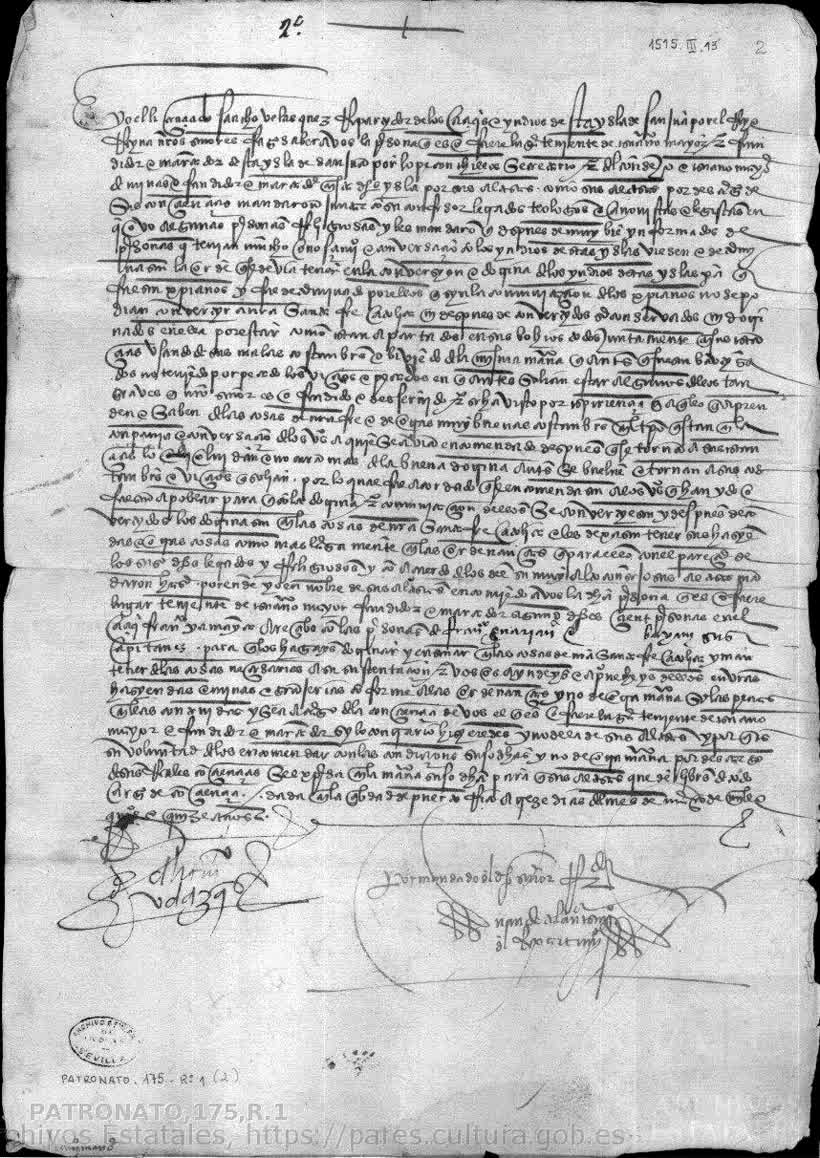

Reading: franco yamayca A·r·e·ç·a·b·o
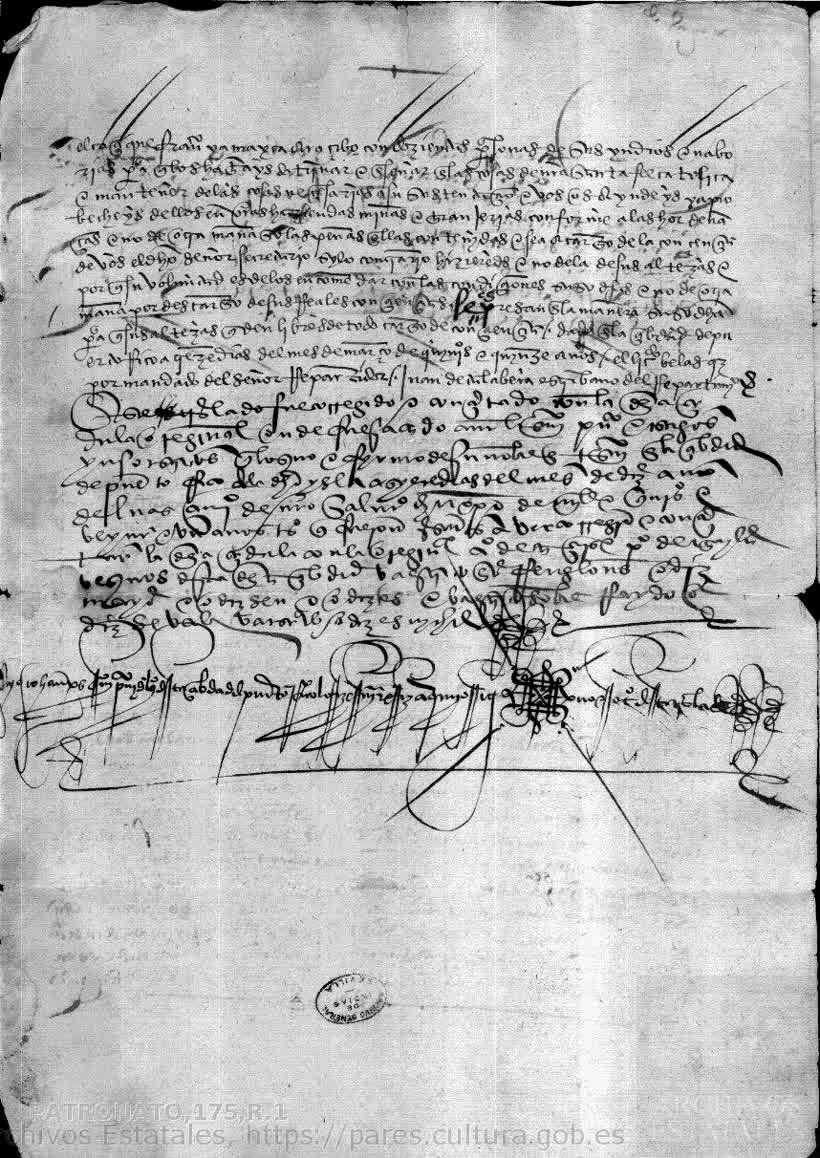

Reading: franco yamayta a·r·a·ç·i·b·o
The ç is the cedilla of 16th-century Castilian and sounded like an s: “Araçibo” reads “Arasibo.” No scribe ever wrote it the same way twice. The spelling with an s was fixed by Coll y Toste in 1907, in his Prehistoria de Puerto Rico; in 1891, in his Crónicas de Arecibo, he himself still wrote “Aracibo.”
Archivo General de Indias, Patronato, 175, R.1 · Image source: Ministry of Culture (Spain) — PARES.
The name · letter by letter
Five centuries of spelling it, and never the same way twice.
1515 · March 13
Areçabo
Francisco yamayca Areçabo
1521 · December 7
Araçibo
Francisco yamayta araçibo
1854
Aracibo
Francisco Jamayca Aracibo

1866
Aracibo
Francisco Jamayca Aracibo

1889
Areziba
Areziba

1891
Aracibo
el cacique Aracibo

1894
Arazibo
Francisco Jamaica Arazibo

1907
Arasibo
Arasibo
«Preferimos escribir siba con s, porque el boriqueño no ceceaba»
1515 · March 13
Order by Sancho Velázquez, distributor of Indians · Archivo General de Indias, Patronato 175, R.1, f.2r, line 25
«çient personas en el caçique Francisco yamayca Areçabo»
The first time anyone writes the name. A distributor of Indians, handing him over with a hundred people to the deputy of a king’s secretary. With an e, a ç, an a.
1521 · December 7
Notarial copy of the sister order (the two-hundred one) · same file, f.5v, line 1
«el caçique Francisco yamayta araçibo con dozientas personas»
Six years later another scribe copies the sister order and already spells it differently: an a, an i, and a cedilla you can actually see this time. This is the copy that will reach the printing press.
1854
Alejandro Tapia y Rivera, Biblioteca histórica de Puerto-Rico, p. 347
«el cacique Francisco Jamayca Aracibo con doscientas personas»
Three hundred years in the king’s archives. Tapia prints it for the first time and the ç becomes a c: the press had no patience for cedillas.
1866
José Julián Acosta, notes to Abbad y Lasierra’s Historia, pp. 93–94
«el Cacique Francisco Jamayca Aracibo con 200 personas de sus indios»
Acosta reprints it in his notes and, in his own, already writes “Jamaica” plainly. This is where Brau will read it.
1889
Agustín Stahl, Los indios borinqueños, p. 67
«Areziba, cuyo distrito se hallaba en la demarcación que hoy ocupa la villa de Arecibo»
Stahl makes him lord of a district — with a z, ending in a — and supposes him in the fighting, under Guaybana. No chronicler saw him there.
1891
Cayetano Coll y Toste, Crónicas de Arecibo
«encomiendan á su secretario Lope Conchillos el cacique Aracibo con doscientos indios y naborías»
Coll y Toste, who is from Arecibo, still spells it like Tapia: with a c. The s will reach him sixteen years later.
1894
Salvador Brau, Puerto Rico y su historia: investigaciones críticas, p. 144
«el cacique Francisco Jamaica Arazibo… sonando junto á éste el de Jamaica, nombre correspondiente á la isla»
Brau spells it with a z and reads the other name: Jamaica. He suspects the man was not from here — an Indian brought from another island — and that “cacique” meant foreman. He is the historian the film speaks of.
1907
Cayetano Coll y Toste, Prehistoria de Puerto Rico, vocabulary
The s is from 1907. Coll y Toste put it there on purpose, and that is the form that reached the town’s coat of arms: the crown, the municipality explains, is that of “Cacique Francisco Xalamanca Arasibo.”
The s is from 1907; the i, from 1521; the e, from 1515. No scribe ever wrote it the same way twice.
Archivo General de Indias (PARES) · Tapia 1854 · Acosta 1866 · Stahl 1889 · Coll y Toste 1891 and 1907 · Brau 1894 · Wikipedia history · Wayback Machine. Every witness, with its source →
Beneath
The Taíno, with their thousands of years, are newcomers here.
Today
Arete Libre, 5.10a. No rope, the Atlantic below.
A crew of three and some friends. The first moves are the dangerous ones: down there it’s still rock, not sea. Above pulls; below swallows.
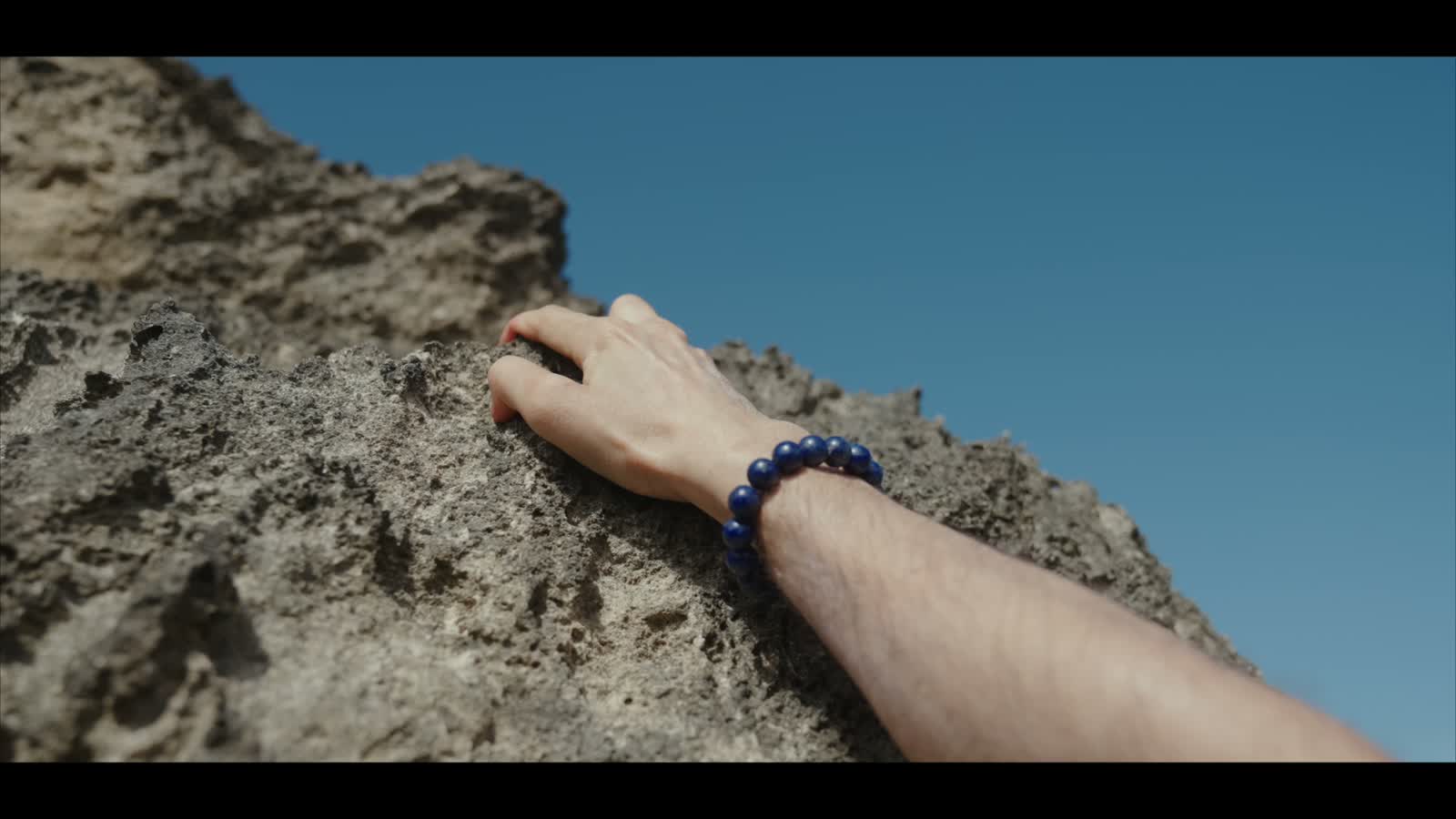
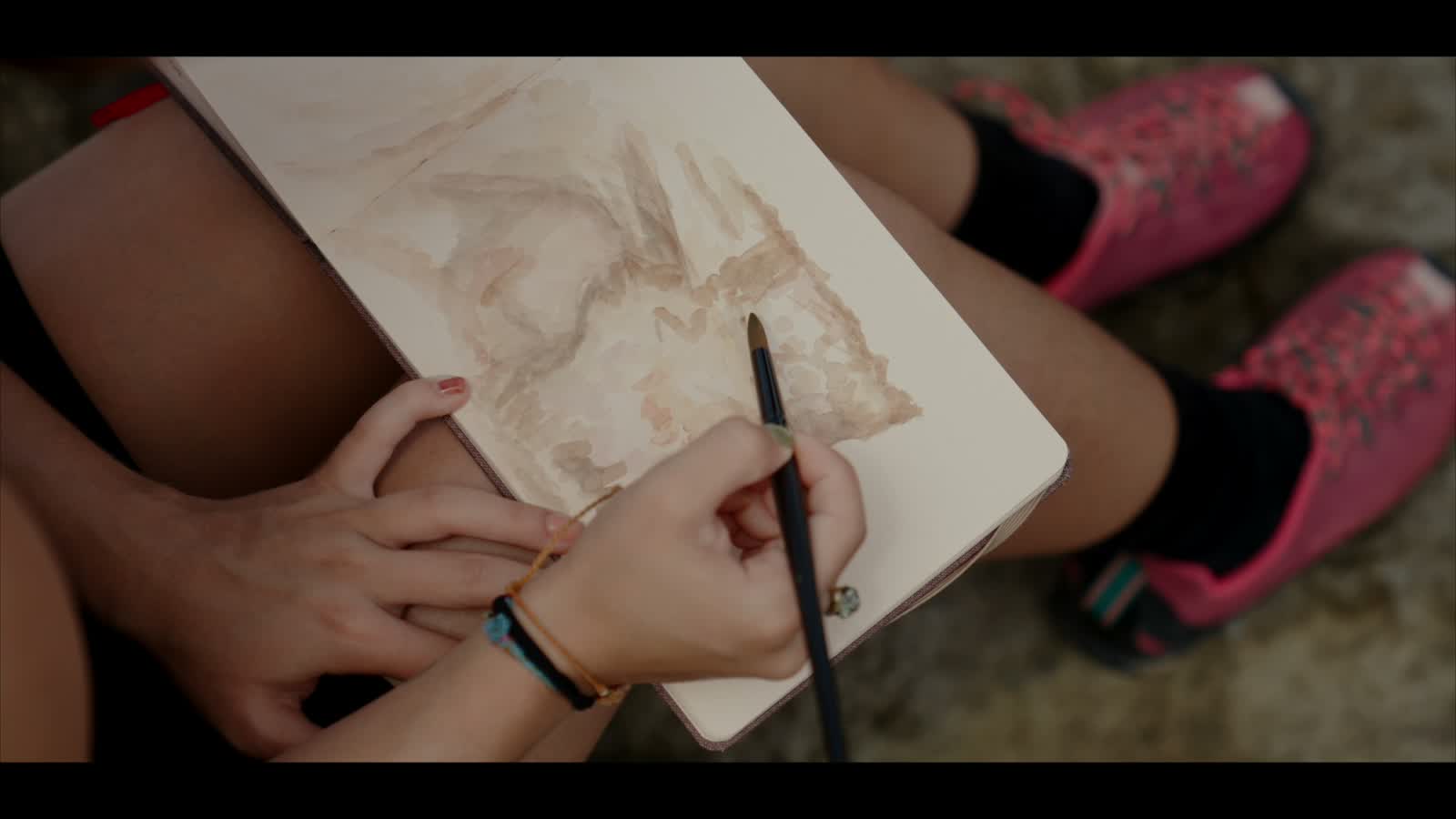
The hand on the rock; the hand on the paper. Marcela M. Zegrí Hernández painting “Arete Libre” from the shore. Film stills. More than 500 years ago
Faces carved into the rock of the cave.
The cemíes in the stone and the opías — the dead — coming out at night to eat guava. At dusk, bats come out of the cracks. They really do.
Of an entire language, some two hundred words remain, six sentences. They had a whole world.
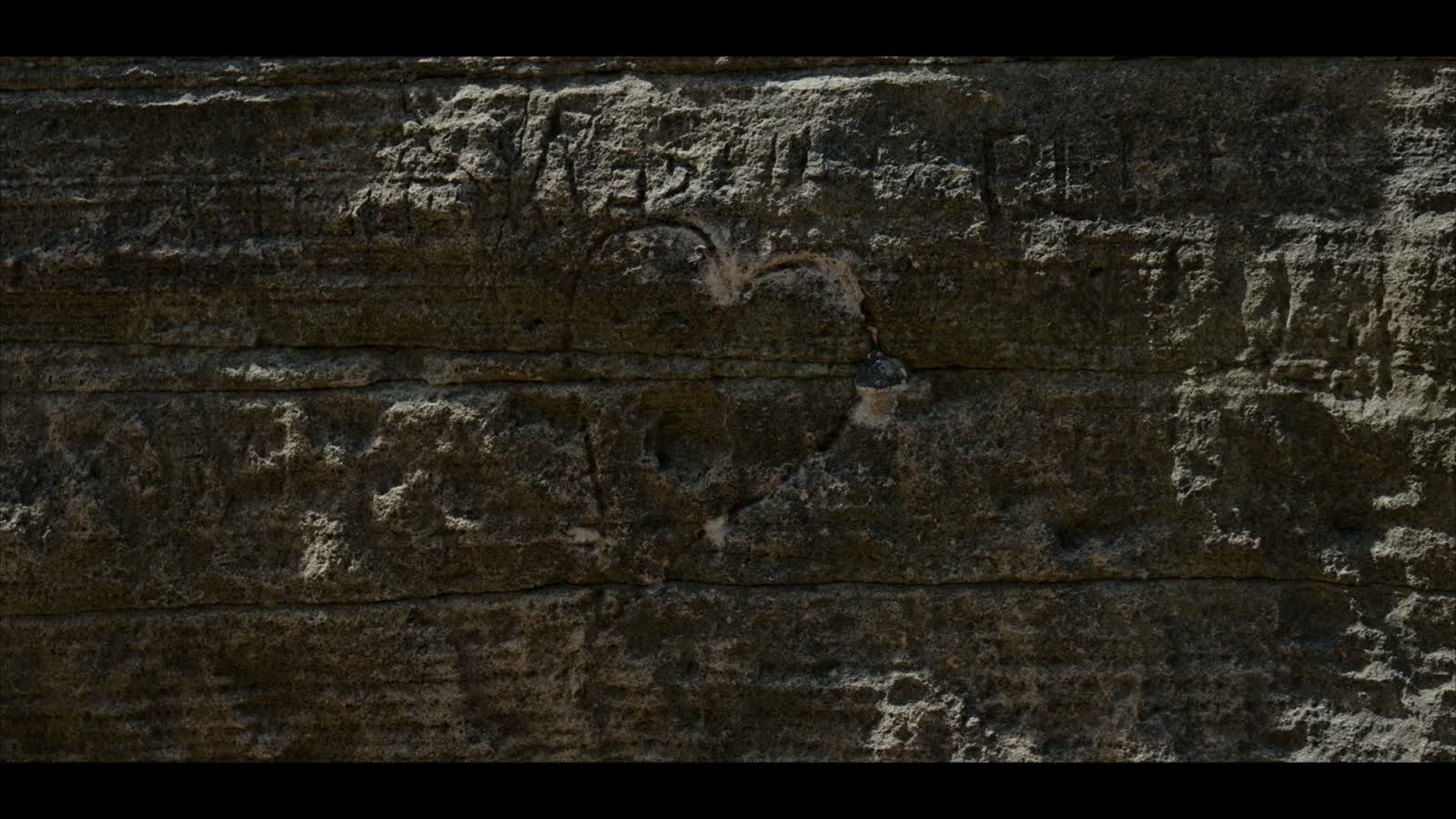
What was put on the stone: a name scratched last week, on the wall of the cave. Film still. Ice Age · what you touch
A dune turned to rock.
The sea made sand out of its own dead — shells, corals, algae — the wind piled it up and water glued it back into stone. What he holds in his hand is the dead, remade. And the same sea, down there, is eating it back, grain by grain.
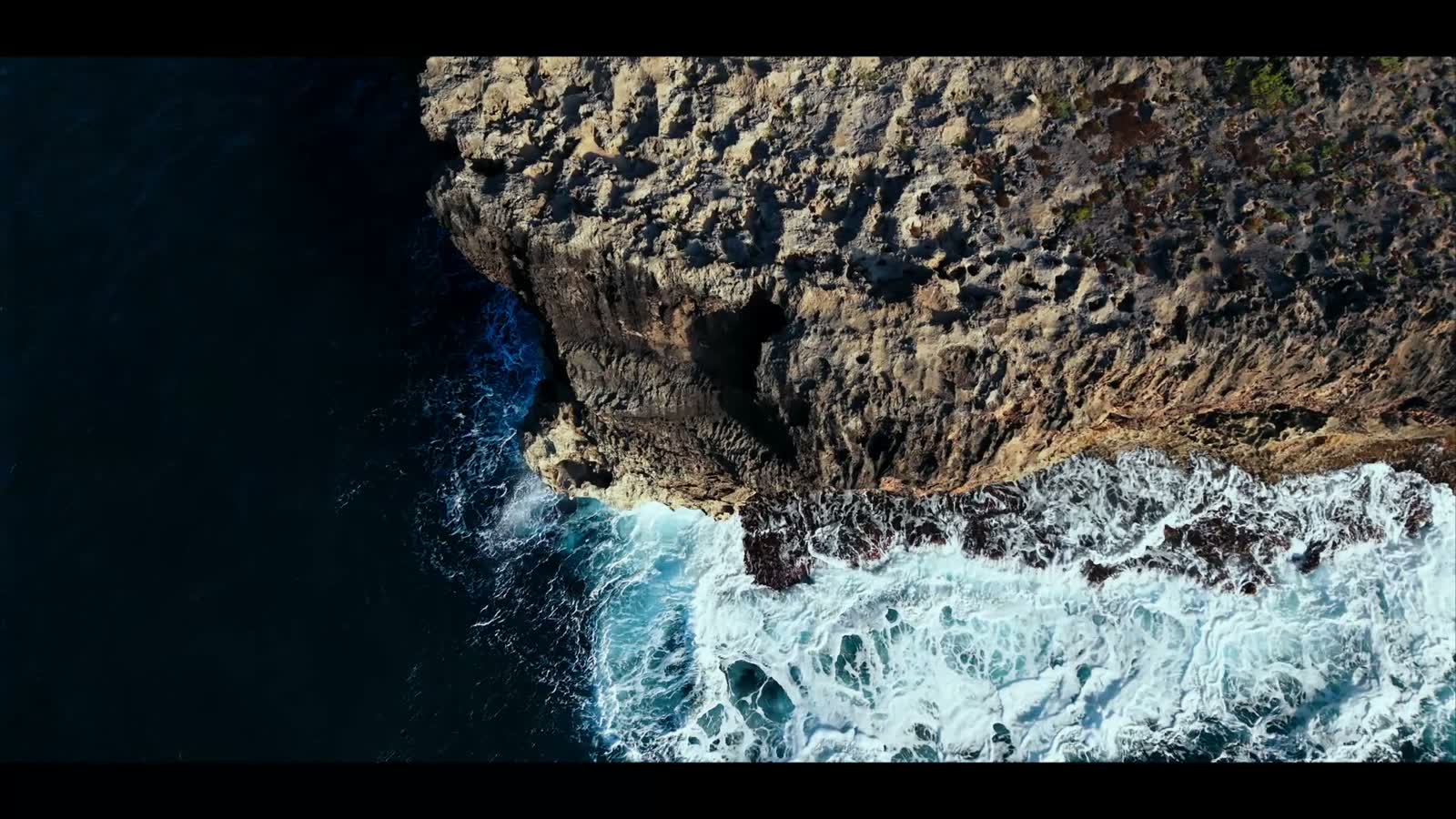
The same sea, down there, eating it back. Film still. 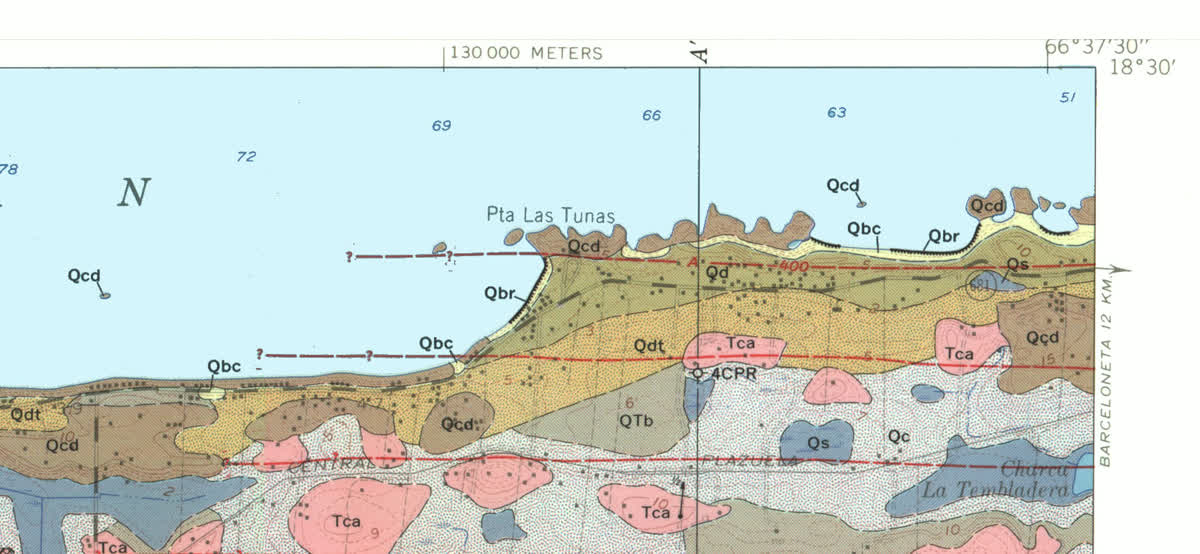
Key · what the colors mean
- Qbc
Beach deposits
Recent — carbonate sand: ground shells and marine skeletons, plus grains the sea tears off the cemented dunes - Qbr
Beach rock
Recent — beach sand cemented by calcite - Qd
Dune sand
Recent — loose sand, same as the beach beside it - Qdt
Transitional deposits
Recent — dune and beach sand the wind spreads, in thin veneers, over everything else - Qs
Swamp deposits
Recent — black or gray clay, waterlogged - Qc
Lagoonal deposits
Pleistocene — old lagoon and swamp bottoms, near sea level - Qcd
Cemented dunes — eolianite
Pleistocene — the wall being climbed - QTb
Blanket deposits
Miocene to Recent — sand and clay stranded on the limestone as water dissolved it - Tca
Camuy Limestone
Miocene — the old stone, beside and beneath the wall - Structure contours — underground elevation of the top of the Aguada Limestone; “?” where probable
- Section A–A′ — the line of the sheet’s geologic cross section
- 4CPR — test well: where the limestone’s thickness (171 m) comes from
The film’s coast on the 1968 geologic map: Punta Las Tunas and Islote, next to Cueva del Indio. Each color is a different rock and a different age; the film’s two are marked. USGS I-551 (Briggs, 1968), scale 1:20,000, public domain. - Qbc
Beach deposits
Miocene · what holds
A warm turquoise sea, a coral shallow behind the reef.
No river to cloud it. The island — old volcanoes, already worn down — was low land, no mountains yet. Creatures no one will ever name fell to the bottom, layer upon layer, and became the stone that holds up the whole coast.
The sea had a king: the megalodon — eighteen meters, three times a great white. Its teeth still turn up in the karst.
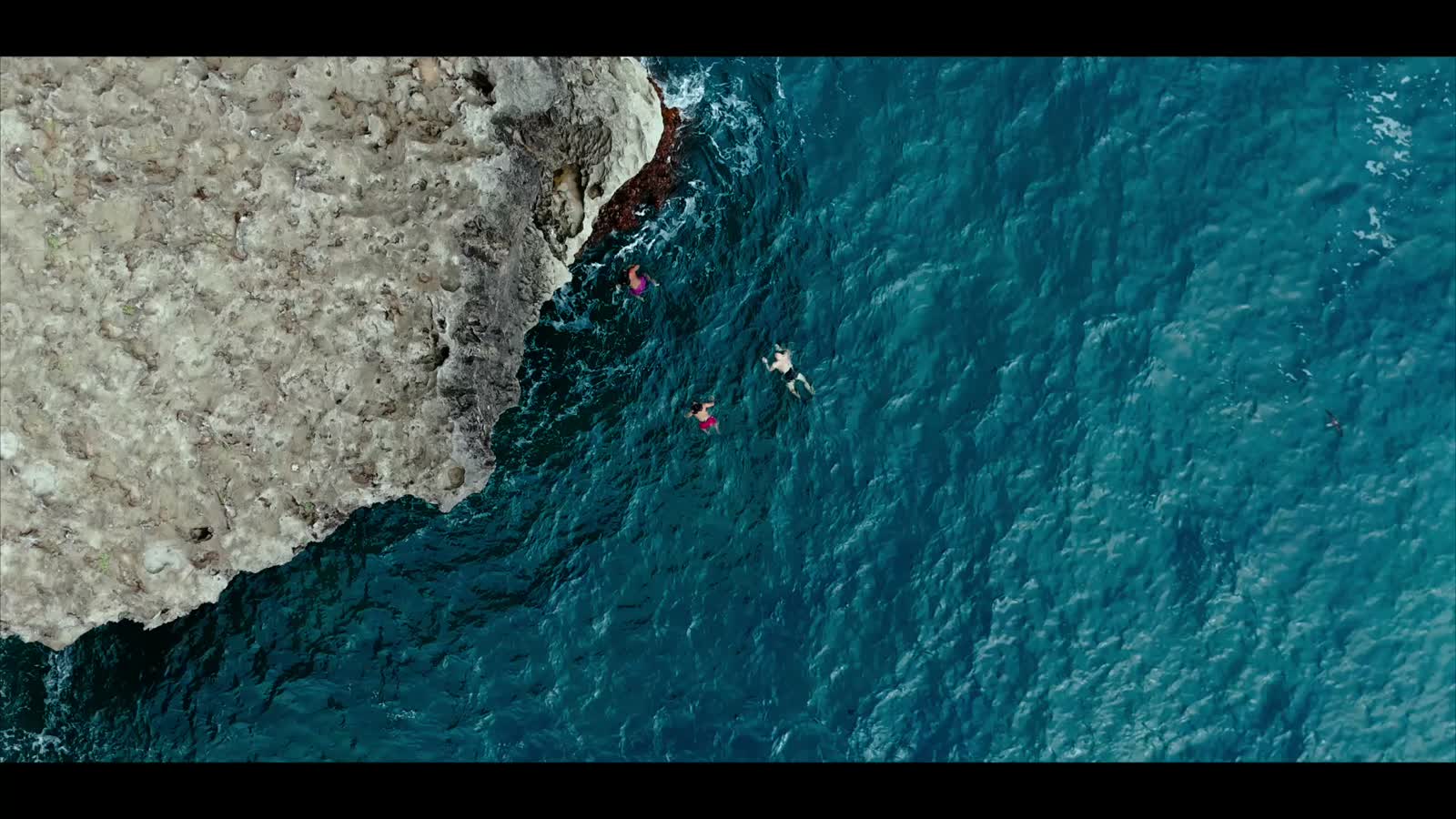
The same sea, today. Film still. 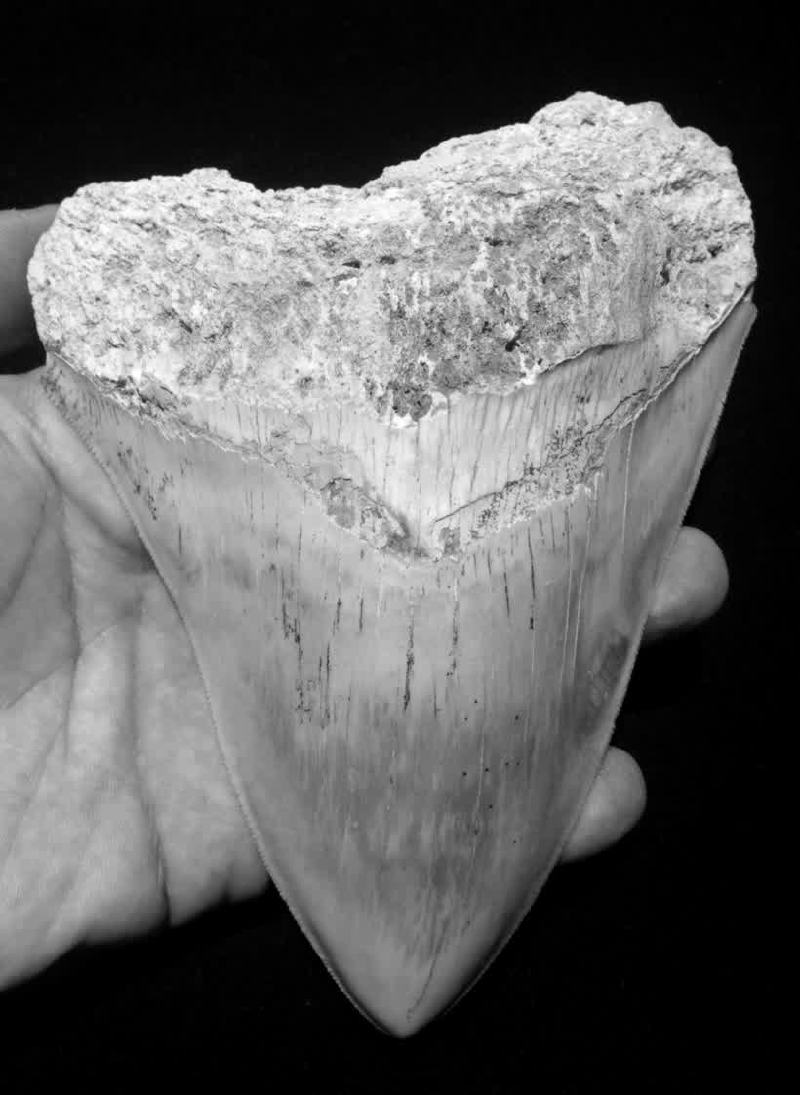
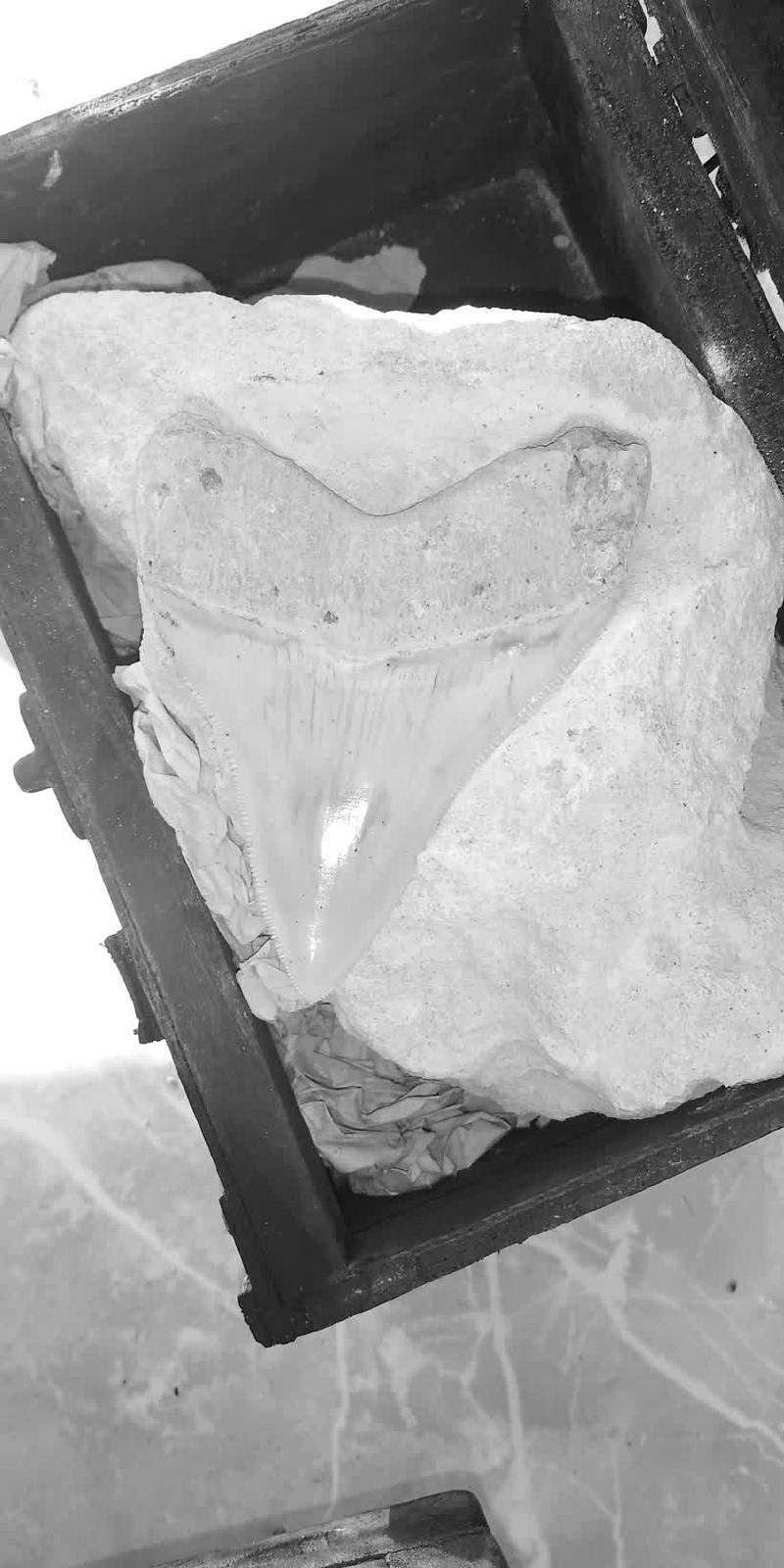
Megalodon teeth from the northern karst: one found in southern Isabela (left) and another in Moca, still inside the limestone (right). Photos: Weather News P.R. (2020). In February 1992, during excavations by the Isabela municipal landfill, eight teeth turned up embedded in the Aymamón Limestone — middle Miocene, ~16 to ~11 million years ago; the largest about 96 mm tall (Nieves-Rivera, Ruiz-Yantín & Gottfried, 2003).


There are no opías in this stone. No gods listening. And still, when he climbs, he holds on to life made rock. And beneath it, holding it up, the dead of fifteen million years ago.
The rock · anatomy of the wall
What he holds in his hand is an Ice Age dune. What holds it up is seventeen hundred meters of old sea.
The clocks in the column — Quaternary: the last 2.6 million years · Miocene: 23–5 · Oligocene: 34–23 · Eocene: 56–34 million years.
Kaye, Shoreline features and Quaternary shoreline changes, Puerto Rico, USGS PP 317-B (1959) · Briggs, Geologic map of the Arecibo quadrangle, USGS I-551 (1968) · Monroe, Geology of the middle Tertiary formations of Puerto Rico, USGS PP 953 (1980), with Briggs’s (1961) well 4CPR. Every claim, with its source →
01 · The wall
A dune turned to stone.
Eolianite: wind-blown sand, glued with lime. The tilted layers at the top left are laminae of the dune — the flank that faced the sea — falling toward it. The pits are rain dissolving it hole by hole, and the salt the spray leaves behind, loosening grains as it dries. In 1959 a USGS geologist wrote of this ridge that “the whole ridge trembles whenever a large wave strikes it.”
02 · What it is made of
Shells, corals, algae.
Almost every grain was once alive: bits of shell, of coral, plates of calcareous algae, foraminifera. There is quartz, but little. What holds them together is calcite: the same lime as the grains, dissolved by rain and recrystallized between them. And one clue that this was a dune and not a seabed: inside there are almost no marine fossils — the few there are, are land snails.
03 · How it formed
The shore was somewhere else.
In the Ice Age the sea rose and fell with the glaciers, and the cemented dunes mark where the shore once was. Beside the beach of that time, the wind piled the sand into dunes: layer upon layer, the upper ones falling toward the sea. That is why the lines in the wall are tilted.
It rained.
The same water that opens pits outside glues inside: where it runs, it dissolves a little lime; where it dries, it leaves it between the grains as cement. Grain by grain, the dune became rock — the oldest ones tend to be the hardest. Why the lime crystallizes right there, the 1959 report admits it did not know.
And the sea came back.
It rose again and began eating it from below: it carries off the loose sand at the base, opens caves, knocks pieces down. What is left standing is the arête. Arete Libre is a dune halfway to falling.
04 · What lies beneath
Seventeen hundred meters of old sea.
More than sixty years ago, less than a kilometer from the cave, an oil company drilled a test well: 1,684 meters of limestone and marl before touching the old volcanoes. They did not pull up a core: they pulled up cuttings, and between 122 and 171 meters they kept nothing. First the Camuy — the limestone beneath the dune, end of the Miocene, perhaps Pliocene —; then the Aymamón, the coral shallow of the megalodon teeth; half a kilometer down, the Aguada: fifteen million years. And it goes on. This is what they brought up.

Act IV · The crux
The word empties out.
Se vacía la palabra.
The hand closes on the hold. Up. The whole sea below.
Credits
For Puerto Rico’s climbing community
Press
Press kit.
Details
- Title
- Me sostengo de los muertos de hace 15 millones de años
- English title
- Held Up by the 15-Million-Year-Old Dead
- Format
- Essay film · short · climbing film
- Runtime
- ~17 minutes
- Languages
- Spanish, with English subtitles. Lines in English and Japanese.
- Location
- Cueva del Indio, Barrio Islote, Arecibo, Puerto Rico
- Route
- Arete Libre (5.10a / 6a) · deep water solo
- Shoot
- Cueva del Indio and El Bloque · Sony FX3 · Sony A7IV · drone
- Music
- Licensed via Epidemic Sound
- Premiere
- YouTube, late September 2026
The site

Cueva del Indio, Barrio Islote, Arecibo: a natural and marine reserve, and an archaeological site, on Puerto Rico’s north coast. The Taíno petroglyphs are in the cave; the route climbed — Arete Libre — is a few steps away, over the sea, but not in the cave. You don’t climb to the cave: you walk.
On the rock, the shoot took two consecutive mornings. In September 2026 the site entered a new stage: the landowner accepted a voluntary sale and the community organizations leading the case called the first meeting to co-design the reserve’s management plan.
No petroglyph was touched during the shoot.
Arecibo or Arasibo?
The film says Arasibo in the first act, the way the narrator was told it, and in the third it shows the two spellings in the 1515 papers: Areçabo in the original and Araçibo in the certified copy of 1521. The form with an s is Coll y Toste’s (1907), who wanted the Taíno word siba, “stone,” to show inside it. That ara means “people” appears in no Taíno source: that sentence was born on Wikipedia on October 7, 2021. The film doesn’t explain it: it shows both papers on screen, and that’s enough.
Is the rock really 15 million years old?
Not the one being climbed. The wall is an Ice Age dune turned to stone: sand of shells, corals and algae that the sea ground down in the Pleistocene and the wind piled up. Beneath that dune, holding up the whole coast, is the Miocene limestone — fifteen million years, the sea the megalodon swam in. That’s what the title is about: what holds, not what you touch.
Does it take a position on the access case?
No. The video mentions no law and no legal process. It’s about the place: the stone, memory and physical danger. The site’s context — the court sanction of August 2026 and September’s new stage — is in the press release, not in the film.
Materials available on request
- High-resolution still
- 15–30 second trailer
- Director’s photo
- Frame of the petroglyphs
- Aerial of the access to the reserve
- Press release in Spanish; title and logline in English
- Private link to the film, before the premiere, for press and programmers
Contact
Gabriel J. Pérez Irizarry
References — what the film claims, and where it comes from →